Emergency Dialysis: When Every Minute Counts

ICU Is Not the End: The Truth Every Family Must Know
August 20, 2026
Contraception Options for Women: A Complete Guide
August 27, 2026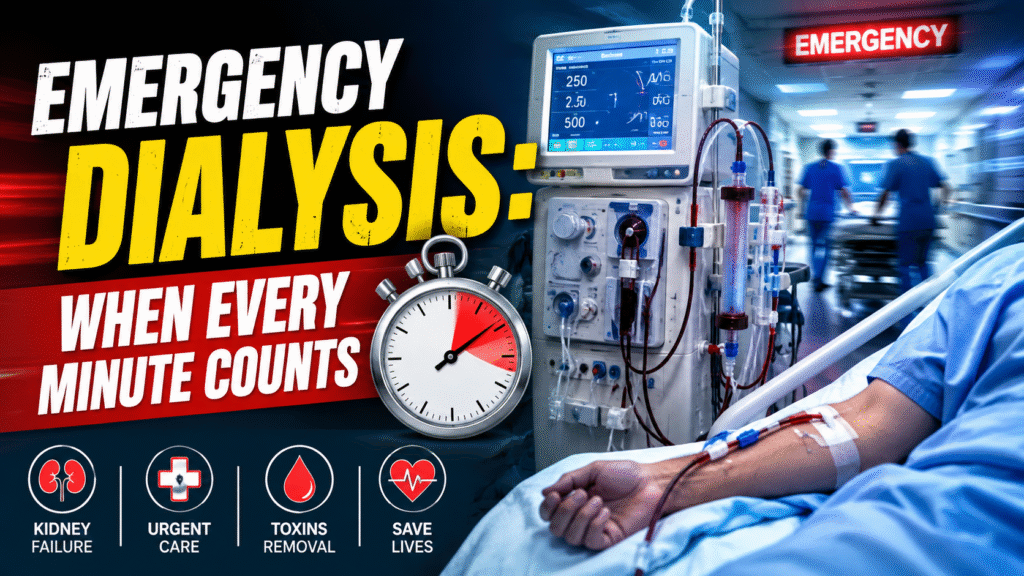
By Dr. Rishabh Gautam | Critical Care & Intensive Care Specialist
When the kidneys suddenly stop working properly, dangerous waste products, excess fluid, and electrolytes can build up in the blood. In some situations, these changes can become life-threatening within hours. Emergency Dialysis in Unnao may be required when kidney dysfunction leads to serious complications that cannot be safely controlled with medicines and supportive care alone.
This is where emergency dialysis can become a lifesaving treatment.
Dialysis is not only a planned treatment for people with long-standing kidney disease. It can also be urgently required in patients with acute kidney injury (AKI), severe hyperkalemia, fluid overload, severe metabolic acidosis, or certain poisonings.
Knowing when emergency dialysis is needed can help patients and families understand why doctors may recommend immediate treatment.
What Is Emergency Dialysis?
Emergency dialysis is dialysis performed urgently when kidney dysfunction has caused a potentially life-threatening problem that cannot be adequately corrected with medicines and supportive treatment alone.
Unlike routine dialysis, where treatment may be scheduled in advance, emergency dialysis is based on the patient’s clinical condition and laboratory findings.
The goal is to rapidly:
- Remove excess potassium
- Correct severe metabolic disturbances
- Remove excess fluid
- Reduce the accumulation of toxic waste products
- Correct severe metabolic acidosis
- Remove certain dialyzable toxins or drugs when appropriate
When Is Emergency Dialysis Needed?
Doctors consider emergency dialysis when kidney failure causes complications that threaten vital organs.
1. Dangerously High Potassium
One of the most important reasons for emergency dialysis is severe hyperkalemia.
Potassium is essential for normal muscle and heart function. However, when potassium becomes dangerously high, it can cause:
- Abnormal heart rhythms
- Muscle weakness
- Conduction abnormalities on ECG
- Ventricular arrhythmias
- Cardiac arrest
Emergency medicines can temporarily shift potassium into cells, but dialysis can remove potassium from the body more definitively.
High potassium can become a cardiac emergency even when the patient does not feel severely unwell.
2. Severe Fluid Overload
When damaged kidneys cannot remove enough water and salt, fluid may accumulate in the body.
Severe fluid overload can lead to:
- Breathlessness
- Pulmonary edema
- Low oxygen levels
- Difficulty lying flat
- Worsening heart failure
If fluid overload does not respond adequately to diuretics and supportive treatment, urgent dialysis or another form of renal replacement therapy may be necessary.
3. Severe Metabolic Acidosis
Kidneys play an important role in maintaining the body’s acid-base balance.
Severe kidney dysfunction can cause metabolic acidosis, where excessive acid accumulates in the blood.
Severe acidosis can affect:
- Heart function
- Blood pressure
- Breathing
- Circulation
- Cellular metabolism
In selected severe cases, dialysis may be required when medical treatment is insufficient or the underlying problem cannot be rapidly corrected.
4. Severe Uremia
When kidney function falls significantly, waste products can accumulate in the blood. This condition is known as uremia.
Severe uremia may cause:
- Confusion or altered consciousness
- Severe nausea and vomiting
- Loss of appetite
- Extreme weakness
- Pericarditis
- Bleeding tendency in severe cases
- Neurological symptoms
When uremic complications become clinically significant, dialysis may be urgently required.
5. Certain Poisonings and Drug Overdoses
Dialysis can sometimes be used to remove particular toxins or medications from the bloodstream.
Whether dialysis is useful depends on factors such as:
- The specific substance involved
- The amount taken
- Blood concentration
- Time since exposure
- Kidney function
- The drug’s molecular characteristics
This is why suspected poisoning or overdose should be treated as a medical emergency.
The Important Rule: AEIOU
A commonly used clinical framework for remembering major indications for urgent dialysis is AEIOU:
A – Acidosis
Severe metabolic acidosis that is refractory to appropriate medical treatment.
E – Electrolyte abnormalities
Especially severe or refractory hyperkalemia.
I – Intoxication
Certain toxic substances or drug overdoses that are dialyzable.
O – Overload
Severe fluid overload, particularly pulmonary edema, is not responding adequately to medical treatment.
U – Uremia
Serious complications of uremia, such as encephalopathy or pericarditis.
However, dialysis decisions should never be based on a single number alone. The overall clinical condition, trends in laboratory values, urine output, response to treatment, ECG findings, and underlying illness all matter.
Does Every Patient With High Creatinine Need Emergency Dialysis?
No.
A high creatinine level does not automatically mean that emergency dialysis is required.
Some patients can have very high creatinine levels but remain clinically stable and may be managed with careful monitoring and treatment of the underlying cause.
Conversely, a patient with an acute and rapidly rising potassium level, severe pulmonary edema, or severe acidosis may require urgent dialysis even before creatinine reaches extremely high levels.
The decision depends on the patient, not just the report.
Emergency Dialysis in Acute Kidney Injury
Acute kidney injury can develop suddenly because of conditions such as:
- Severe infection or sepsis
- Dehydration
- Shock
- Major blood loss
- Certain medications
- Severe heart failure
- Urinary obstruction
- Major surgery
- Trauma
- Severe burns
Some patients recover kidney function once the underlying cause is treated.
Others may temporarily require dialysis while their kidneys recover.
Needing dialysis during an episode of acute kidney injury does not necessarily mean that dialysis will be permanent.
What Happens During Emergency Dialysis?
Before dialysis, the medical team assesses the patient’s:
- Blood pressure
- Heart rhythm
- Oxygenation
- Electrolytes
- Kidney function
- Acid-base status
- Fluid balance
- Urine output
- Overall clinical condition
A suitable vascular access is then established.
Depending on the patient’s condition, conventional hemodialysis or another form of continuous renal replacement therapy (CRRT) may be selected.
Critically ill patients with unstable blood pressure may require continuous or slower forms of renal replacement therapy rather than conventional intermittent dialysis.
Why Timing Matters
In emergencies, waiting too long can allow dangerous abnormalities to worsen.
For example, severe hyperkalemia can progress from an abnormal ECG to a life-threatening arrhythmia. Similarly, uncontrolled pulmonary edema can lead to severe hypoxia and respiratory failure.
Therefore, when a treating team recommends urgent dialysis, the recommendation is often based on the risk of complications developing rapidly rather than simply on the kidney function report.
Can Medicines Replace Emergency Dialysis?
Sometimes—but not always.
Doctors may initially use treatments such as:
- Intravenous calcium when indicated for severe hyperkalemia with cardiac membrane instability
- Insulin and glucose
- Beta-agonists
- Diuretics in appropriate patients
- Bicarbonate in selected cases
- Fluid management
- Treatment of infection, shock, obstruction, or other underlying causes
These treatments can stabilize the patient or temporarily correct abnormalities.
However, when the underlying problem cannot be adequately controlled, dialysis may be necessary to remove excess potassium, fluid, acid, or toxins from the body.
What Families Should Know
If a doctor recommends emergency dialysis, families often worry:
“Does this mean the kidneys have permanently failed?”
Not necessarily.
Emergency dialysis may be temporary, particularly in acute kidney injury.
The kidneys may recover partially or completely depending on the cause and severity of the injury.
The immediate priority is to stabilize the patient and prevent complications involving the heart, lungs, brain, and other organs.
When Should You Seek Emergency Medical Care?
A patient with known kidney disease should seek urgent medical attention if there is:
- Severe breathlessness
- Chest discomfort
- New confusion or excessive drowsiness
- Severe weakness
- Palpitations
- Markedly reduced or absent urine output
- Persistent vomiting
- Sudden swelling with breathing difficulty
- Fainting or collapse
Patients with known kidney disease should also follow their physician’s recommendations regarding laboratory monitoring, medications, fluid intake, and dialysis schedules.
The Take-Home Message
Emergency dialysis is not simply about a high creatinine value. It is about preventing life-threatening complications caused by kidney failure.
Severe hyperkalemia, refractory acidosis, fluid overload, uremic complications, and certain poisonings are among the serious situations where urgent dialysis may save a life.
The most important principle is simple:
When kidney failure starts threatening the heart, lungs, brain, or overall stability of the patient, every minute matters.
Early recognition, timely referral, appropriate medical stabilization, and access to a facility capable of providing 24×7 emergency and dialysis services can make a critical difference.
If you or your family member has kidney disease and develops sudden breathlessness, severe weakness, confusion, markedly reduced urine output, or other alarming symptoms, seek emergency medical care immediately.
Frequently Asked Questions
Is emergency dialysis always permanent?
No. Dialysis may be temporary in patients with acute kidney injury if kidney function subsequently recovers.
Does a high creatinine automatically mean dialysis?
No. The decision depends on the patient’s overall condition and complications, not creatinine alone.
Can high potassium cause cardiac arrest?
Yes. Severe hyperkalemia can cause dangerous cardiac rhythm disturbances and cardiac arrest.
Can dialysis remove excess fluid?
Yes. Dialysis can remove excess water and salt when the kidneys cannot do so adequately.
Is emergency dialysis painful?
Dialysis itself is generally not painful, although insertion of a temporary dialysis catheter or creation of vascular access can cause discomfort.
Can an ICU patient receive dialysis?
Yes. Critically ill patients can receive renal replacement therapy, including continuous therapies such as CRRT, when clinically indicated.
Conclusion
Emergency dialysis can be an essential treatment when kidney dysfunction causes serious complications involving the heart, lungs, brain, or overall metabolic stability. Recognizing warning signs and seeking timely medical care can help reduce the risk of life-threatening complications. Abhisri Hospital can serve as an important point of care for patients who require urgent medical evaluation and appropriate dialysis support.